
The Capitanata Coastal Irrigation District (CID), Italy
The Capitanata irrigation and reclamation district is located in the northern part of the Apulia region in Southern Italy, covering a 4410 km2 area surrounding the city of Foggia, between the Saccione river (North), the mountainous Gargano promontory (North East), the Adriatic sea (East), the Ofanto river (South) and the Apulian Apennines range (West). Almost two thirds of the area, about 3000 km2, is the Tavoliere delle Puglie alluvial plain, the second largest plain in Italy, mainly cultivated with herbaceous crops, olives, fruit and grapevine trees.
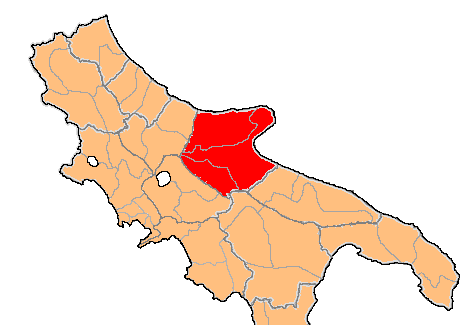
The Capitanata irrigation district is composed by three pressurized, on-demand, water distribution schemes: the Sinistra Ofanto and the Carapelle systems in the Southern part, and the Fortore system – fed by the 250 hm3 Occhito reservoir at the border between the Apulia, Campania and Molise regions – in the Northern and Central parts
Nowadays, Capitanata is still an important subregion of Apulia in which the prevalent activities are agriculture and farming. It is divided into three main areas, with different characteristics:the plane area, the Tavoliere of Puglia, for centuries mainly used for intensive farming, and now cultivated mainly with cereals, but also olives and fruit and vine trees, and the Gargano area, cultivated mainly with citrus fruits thanks to the high presence of water in the subsoil.Other important crops, for which this region is among the first in the whole Italy, are wheat,oats, potatoes and tomatoes. Livestock mainly concerns sheep, but also pigs (in particular in the area of Gargano) and equines.
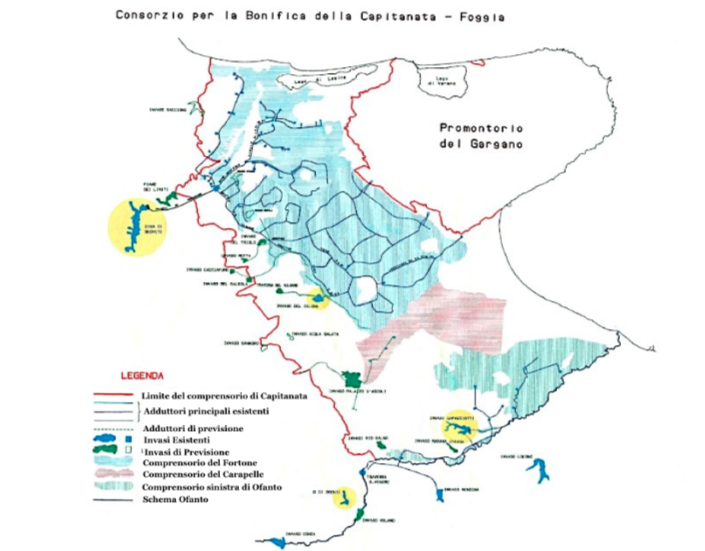
The area that will be taken into consideration for the study of this thesis is a smaller part of the whole region, the consortium of Bonifica della Capitanata, that extends over a district of around 441.000 hectares, starting from the stream Saccione in the Northern part, to the border between provinces of Bari and Foggia represented by the Ofanto river, as shown in the figure 2.It is characterized by three water schemes: Fortore, Sinistra Ofanto e Carapelle, over a surface of around 200.000 hectares and it is one of the greatest and most important irrigation consortium in the Mediterranean region. It had been founded already in 1934 when nine basin Consortia were gathered into a unique Consortium that was called Consorzio Generale per la Bonifica della Capitanata.
The initial activities of the Consortium were aimed at recovering agricultural lands through hydraulic regulation works with amelioration of unhealthy areas to eradicate malaria and to create livable life conditions in the countryside. Only twenty years later (at the beginning of the 50s), the decisive role irrigation would have played in the subsequent cropping and economic transformation of the land became evident with all the consequences on the agricultural economic development of Capitanata and the community as a whole.
The results of all activities were indeed very impressive with a change in the landscape anda progressive increase of the population in the main flat built-up areas. The latter, rehabilitatedand reclaimed from a healthy and sanitary point of view, provided the inhabitants of the smalltowns located in hilly and mountain areas, favored so far for their healthiness, with betterpossibilities of economic growth and development.From 1931 to 1998 the population density within the reclamation scheme increased a lot.The flat built-up areas were those that grew most including Foggia, Lucera, Manfredonia, SanSevero and Cerignola.
Nowadays, in the area covered by the consortium are living about 550.000 inhabitants. The surface area covered by the consortium water distribution network is about 140.000 ha and about 90% of it (126.000 ha) is effectively under functioning.The irrigated land is slightly smaller and it is estimated to about 121.000 ha (27.5% of total area). However, only 45% of it is irrigated through the Consortium water distribution network,while the rest is located within the Consortium but is irrigated directly by the farmers using the private wells.This is why in last decades the quantity of water for the primary services such as agriculture and farming has been reduced because of the increasing demand for drinkable water, and delays in the irrigation water supply is still a big problem in the Capitanata consortium, due also to the climate typology of Southern Italy characterized by a low amount of rain during all the year.Given the importance of this region in the Mediterranean area, in literature a lot of studies and experimental works have been carried out regarding the territory of Capitanata, especially regarding water consumption of crops, in order to determine the amount of water needed for irrigation.
Capitanata has been studied also under a climatic point of view in order to understand possible trends and analyze the daily weather data extreme, since the impact of the climate change can have important repercussion especially on agriculture. It has been stated that the increase in surface temperature is in particular due to the summer season, having an intensification of the number of heat waves, while no significant trends was found in precipitation series, with except to a weakly increase in the number of the intense precipitation events. These trends, even if significant, must be considered with precaution; in fact, they are only relative to the last 30 years, so it could be influenced by cycles at long timescale.
References:
Stefano Barontini, Martina Greta Caffi, Muhammad Faisal Hanif, Elpida Kolokytha, Dimitrios Malamataris, Hiba Mohammad, Marco Peli; A parsimonious agroclimatic methodology to assess the hydrological sustainability of agriculture in the Mediterranean semiarid climate. Hydrological Sciences Journal, 2025 (Under review)
Marco Peli, Cesare Rapuzzi, Stefano Barontini, Roberto Ranzi; Application of Benfratello’s method to estimate the spatio-temporal variability of the irrigation deficit in a Mediterranean semiarid climate. Hydrology Research 1 April 2023; 54 (4): 451–474. doi: https://doi.org/10.2166/nh.2023.081
Cesare Rapuzzi; Agricultural water balance in a semiarid climate: The Capitanata case. Master’s Thesis, MSc in Civil and Environmental Engineering, University of Brescia, Italy, 2020.